Showing posts with label cultural lesson. Show all posts

Friday, May 18, 2012

Awesome thing #342 about Germany: The trains


Day 5 in the motherland. Germany continues to impress me. Remember my big cultural lesson about how great the French train system was? I think I was coming from an uninformed perspective. Any train system looks great next to the relatively nonexistent one in the United States.

  1. German trains are actually on time. Inconceivable! Lindsey and I have been taking the train daily for our day trips and never once has a train been late. It's nice to know that you can count on making a connection and that you can accurately plan your day.
  2. German trains actually check your tickets. This is nice because a lot of the time on French trains I wondered why I had wasted my money on a ticket they wouldn't even check (the answer: because I am honest).
     
  3. German trains give you great stories. Friday night train rides out of Munich have no shortage of activity. Lindsey and I were accused (in German) of being Chelsea fans by a dusty old German man drinking beer from his backpack. Another older German man heard us speaking English and asked if we could explain the one English word he didn't understand: stillbirth (he had seen it in a health warning on his cigars). At one point, the four German men in our car were shouting about the upcoming Champions League Final match this weekend and all Lindsey and I could understand were town names and Amerika and JA!!! Never a dull moment.

I, of course, will be cheering for FC Bayern

Wednesday, May 9, 2012

The gypsy question

Cultural Lesson #12: Gitans (Gypsies)

Anyone who's seen Disney's Hunchback of Notre Dame knows that there are Romani people in France. We recount stories of how they barrage us at tourist monuments in Paris, play the accordion in public squares, and dragoon us in the streets asking for "une petite pièce" (just a coin). I have very mixed feelings about les gitans.

First of all, they are completely aggressive. They bombard you, they don't take no for an answer, they are professional beggars.

But, they are people, too. It breaks my heart to see the whole family on the tram in the morning heading out for a day's work. The boys that are my age get off at one stop with their clipboards, ready to bamboozle and swindle. The children that are in their early teens get off at the next stop with their scrub brushes and soap to try to wash car windows. The men get off at the next stop with their cups to beg for coins. The women get off at the next stop with their young children to beg for money at the tram stop.

And what I find the most disturbing is their exploitation of their children. Why are these children dancing in the streets and playing the accordion and washing car windows instead of going in school, running around outside, learning how to read, and playing? They don't even get to be kids.

So my experience with les gitans has been very distressing. It's almost worse than grappling with the question of how to help SDFs (the homeless) because their way of life is so cyclic and enduring. The kids are "working" as gypsies from day one and I can't imagine that they will ever stop.

So I guess my real question: is it even something I should worry myself with? Is it completely arrogant of me to assume that because these people don't live the way I do, that they need my help?

I'd like your thoughts in the comments.

The reason perfume is so popular in France

Cultural Lesson 11: French Hygiene 

So I'd say that a pretty big American perception of French people is a general lack of hygiene. Jokes about hairy armpits and infrequent bathing abound. While this cultural difference is exaggerated, I'd say there is  the teensiest bit of truth behind it.

  1. Foul odors are a lot more acceptable in France. You rarely hear anyone complaining about bad smells.
  2. There seems to be a gap in between generations. When I encounter body odor, it's usually older people. This may be the remnants of a culture of hygiene that is dying out with younger generations. My host mother washes her hair once a week on Thursdays (but she does not smell in any way), where as most of my friends from university are anal about taking daily showers. 
  3. There is an undeniable abundance of smells. I have to be honest and say that my nose has definitely been subjected to some new foul odors in France. And it's mostly body odor. But, cities are always smellier than the 'burbs, so I'm not sure if this is due to the fact that I'm in France or that I'm living in a big city (other than DC) for the first time in my life. 

A fun anecdote!

I generally have my encounters with foul odors in enclosed spaces where it's hard to escape (the tram, the bus, church, etc.) The worst encounter I've ever had with body odor was on the tram during rush hour (of course). I noticed the smell just as I had gotten on the tram for my 10 minute tram ride over to Sainte Bernadette, my church. It quickly became overpowering; we're talking watering-eyes and gag reflexes. What was even worse was that no one else was reacting (see #1). Stoic and stone-faced, the French people around me in the tram carried on with their quotidian tram business. I felt like this stench was my personal purgatory.

So I fled to the next tram car. But, in heading away from the person I believed to be the culprit, I ended up even closer to the source of the odor. Pinned into a corner of the tram, I became feverish.  Attempting to use my coat as a filter, I was breathing through my mouth into my elbow. My head was swimming and I was contemplating barreling through a horde of people to get off at the next stop in order to wait for a new tram despite the fact that I was running late. I managed to make it to my stop and literally breathed a sigh of relief.

Clearly, I'm alive. But what I like to call "the funk" is one thing I will not miss about France.

Sunday, May 6, 2012

Les elections françaises

Cultural Lesson #10: French Elections

As a Political Science major and news junkie, I am really quite lucky to be in France to witness the presidential elections which occur once every five years. I have learned a lot about the political atmosphere and the voting process through conversations with my host family and French friends, information from news sources, and lessons from one of my French courses at Accent Français.

The system of voting seems a little archaic in comparison to the American system. The Sunday of the premier tour, the French go to le bureau de vote where they are assigned to vote. They show their identity card and they go into l'isoloir (the voting booth) with many slips of paper with the candidates names written on them. Each voter gets an envelope in which they place their choice of candidate, leaving them to dispose of the other slips in the manner they choose (they throw them away, stuff them in their pockets, etc.). The envelope gets placed in l'urne (a box which holds the votes), the voter signs an electoral list, and that's it! When the voting process is over, the votes are hand-counted. In the case that none of the candidates gets a majority (over 50%) of the votes, there is a deuxième tour two weeks later (today!). The candidates for today are Sarkozy (the incumbent) and Hollande.

The actual voting process is definitely different, but I think there's something to be said about simplicity. At least you don't end up with dead pets voting (shout out to my home state of Illinois) or technical errors in the vote count. Another difference is a type of absentee voting, voter par correspondance, which allows an absentee voter to have someone else physically vote for them. Voter par procuration is what we would consider to be normal absentee voting.

The elections today will very well shape the economic and international role of France. The fate of the economy is definitely the biggest issue here. Supporters of Hollande look at the economic failure of the United States as reasoning to back their candidate, and supporters of Sarkozy look at the economic failure of Greece and Spain as reasoning to back theirs. Another big issue which is tied to this is immigration. Sarkozy maintains that stemming immigration into France would safeguard jobs for French people in a country where the unemployment level is nearly 10% and reduce strain on the welfare programs which are so numerous (well, in comparison to the US) in France. Hollande believes that immigration when it is legal is not a damper to the prosperity of France.

The election results are tallied quite quickly and there is no lame-duck period as we have in the United States. Keep your eyes on the news as France prepares to welcome back Sarkozy or welcome anew Hollande.


Friday, May 4, 2012

Service with a simper

Cultural Lesson # 9: [Lack of] Customer service

Forecast of this blog post: rant with a chance of negativity. Sorry!

We all know the mantra "the customer is always right." Or at least I thought we all did. To put it delicately, customer service has a whole different face in France. It has been one cultural difference that I haven't quite been able to embrace and I frequently find myself thinking "back home, this would never happen." Some examples (from least to greatest level of annoyance):

Exhibit A: The inconsistent peanut butter price
So, like any good study abroad student, I made myself a budget to account for travel, transport, food, and miscellaneous expenses.  For the food, in particular, I relied on prices at the grocery store to make this budget. The great thing about France (and other European countries) is that tax is included in the price of everything. So I can easily calculate exactly what I will spend and always have the right amount of cash ready. Once while going to buy a jar of peanut butter (a cost effective if not French lunch option), I noticed that the price at check out was several euros higher than the listed price. When I made a remark about it, the cashier told me it wasn't her job to check prices and that if I wanted a refund I could take it up with customer service. The desk of which I couldn't even find.

Exhibit B: The uppity banker
So in the beginning of my séjour, I completely forgot the assigned code to my French debit card. After entering my American code three times, the machine ate my card (d'oh!). So the next day I went to the bank with a piece of ID to recuperate it. After waiting in line for ten minutes, I gave the banker a friendly bonjour, explained my situation, and handed over my carte d'identité.  The lady gave me a disgusted look and told me very harshly that my drivers license wasn't a valid form of ID. I was already having a rough day (I'm pretty sure this was a Wednesday in February which means I was cold and I had just suffered through a horrible class), and I just remember being so upset that the lady didn't find it worth her energy to kindly explain to me that I needed a passport. I mean, I AM giving them my money after all.

Exhibit C: The restaurant owners who turn you away
Several times I have been turned away from a restaurant/food stand for no apparent reason. In Paris, we walked by a grillade stand (they serve grilled sausages and kebabs and whatnot) around their closing time. They were starting to pack up, but they had tons of cooked sausages still sitting on the grill. As we tried to order, the lady very rudely told us that they were closed. Also, when trying to sit down outside at a pub around noon, the store owners chased us away and said that it would be "a good fifteen minutes" until we were allowed to sit. We would have been fine with sitting and just waiting to be served, but apparently they were more interested in taking their smoke break than having customers.

Exhibit D: The key saga
This happened back in February. It is such a big story, but I didn't want to write about it until it was over, because I didn't want to jinx anything. So right after February break, I broke my key to the apartment in the lock of the door (just call me super-strength-Kathleen). Luckily, I got the whole key out, but when I showed my host mother she had a very strong reaction (the French don't really hold back with things like that). She told me to buy a new key would cost 130 euro. Holy cats. Whats more, the key had to be made at a special factory in Paris and would take as much as a week to be made (leaving me without a key during this period). So I freaked out and went to the program director because I had no idea what to do. Luckily, we figured out that the one euro insurance I bought at the beginning of the program would cover it (literally, the best one euro I ever spent). Yay!

Long story short, it took me 25 days for the key to get made because there was some problem at the key factory. So I was without a key for nearly a month. Super super super inconvenient because I am definitely the one who comes and goes the most (other than our host mother). I had to make sure someone would be around if I decided to go for a run, or wanted to come home for lunch, etc. My host mother and I literally shouted "HALLELUIAH!" when the key arrived.

Furthermore, working with the insurance company was incredibly frustrating. I filed the claim the day after I broke the key and sent in all of the necessary documentation (receipt for the new key, proof of residence, an attestation of what had happened, and my bank account information), but for one reason or another, there was always something wrong or something that I didn't do quite right (not because I neglected to read directions, but because they didn't TELL me the very particular way that they wanted things). Finally I went to my bankers who are the sweetest guys ever and they called the insurance company and basically told them to stop harassing me and to give me my money. Pascal to the rescue. I am going to miss that guy. I finally got my money just before I left for April break. Ridicule!


Silver lining: I had the best bankers ever (the "uppity banker" was at a different branch). There was a period of time when I was going to the bank at least two times a week for the stupid insurance claim. They were always super patient with me when I had no idea what they were saying (I never learned bank vocab in school... did you?). They helped me write out my letters that I had to send to the insurance company. They joked with me about the Chicago Bulls and loved to throw out the random English phrases they knew. They asked how I was adjusting to French culture and how my classes were going at le fac. And they were always super polite and never made me feel like a stupid American who doesn't know anything and should just not even be in France (which is sometimes how I feel after these customer service interactions). I just closed my account today and was actually kind of sad to say goodbye! Definitely the most pleasant experience I've had concerning service-providers.

Wednesday, May 2, 2012

Trains, planes, and automobiles. But especially trains.

French Cultural Lesson # 8: Le Train

The very first thing I did when I got to France was take a train to Montpellier. I remember feeling so French as I took the TGV for the first time and watched the French countryside whiz by. Throughout my stay here, I've really gotten to know the train system.

The Good: 
Unlike chez moi (back in the States), the train is really the mode of travel here. While there tends to be a Paris-centroism to the system, the network of rail is fairly extensive. In fact, I have done a majority of my traveling by train:
  • Montpellier
  • Avignon
  • Nice
  • Grasse
  • Beaulieu-sur-mer
  • Nimes
  • Sète
  • Cannes
  • Antibes
  • Monaco
  • Menton
  • Ventimille, Italy
  • Paris
  • Versailles
Also, in the French style of offering great discounts to people under 25 (something I'm going to miss a lot when I go back home), there is a discount card you can buy called the douze-vignt-cinq (the 12-25) which is for travelers between those ages. I've used the train so much that the card paid for itself in the first month, and I'd really recommend it to anyone with an extended stay in France who is planning to travel by train!

The bad:

The SNCF (the organization that runs the trains) has a reputation of being a little disorganized. Trains are often behind schedule, sometimes two trains leave from the same platforms at essentially the same time, etc. Suffice it to say, we have had our fair share of train fiascoes. The tardiness of trains is somewhat of a joke among French people. Back in March, a law was passed that requires the SNCF to refund your ticket if you miss a connecting train due to a delay (which seems like an obvious responsibility in my American eyes..).


The ugly:
They don't all look like this, I swear.

Monday, April 30, 2012

Once again embracing the golden retriever

Peur du jour - 30 Avril 2012: Sharing American Culture

So yesterday at the lycée where I volunteer we had our journée americaine (America day). My fellow American students helped to plan and lead a day full of cultural workshops for the English classes here.  We split into about five teams, each one composed of both American and French students. The team captains (the Americans) had to wear different colored bandanas. We were team "Yellow Submarine." Cute, n'est pas?


We had a dance workshop where two Americans thought dances like the Cupid Shuffle, the Soulja Boy, and the Dougie.
Cupid Shuflin'
We had a baseball workshop lead by the Montpellier Baracudas (the baseball team in Montpellier).

Me, stepping up to the plate
We had an quiz on American trivia and music at which the French students did surprisingly well. They knew a lot about American geography, politics, and pop culture!

In the spirit of America, our kids were very competitive
The consul from the American consulate in Marseilles came to share a word about the importance of sharing and understanding different cultures.


The cafeteria even made an American style lunch for all of us! We had chicken wings, "country potatoes", chocolate milk, cookies, and "sundaes" (little ice cream cups). There were still, however, baguettes, French style appetizers, and real silverware and plates. Much nicer than my high school cafeteria.

A very delicious meal


We had an art workshop where we made pieces in the style of Keith Haring, an American artist. We traced the forms of each other and then designed the interior and the exterior in contrasting colors. This was probably the most fun I've had in a long time. The kids were SO creative and it has probably been at least a decade since I've gotten to have arts and crafts time (other than my stress-time coloring books).

We didn't get time to finish, but I still think it's pretty cool!

It was really fun to get to know some of the students I work with better. It also felt pretty good to just be our goofy, kind of loud, enthusiastic American selves. While in Montpellier, I've really tried to make a connection with the natives around me. Even though this day was kind of about us, I still really felt that we connected with French culture. Our students taught us a French dance, we got to see more about French high schools, and we got to just hang out with the students and talk with them. It was a very long and tiring day, but one of my best in Montpellier! (and that rhymed!)

Tuesday, April 24, 2012

Final thoughts about Paris


Paris was just as magical as everyone has always said it would be. In fact, it was more magical.

La tour eiffel from le centre pompidou
I have had a lot of contact with people who talk Paris down:

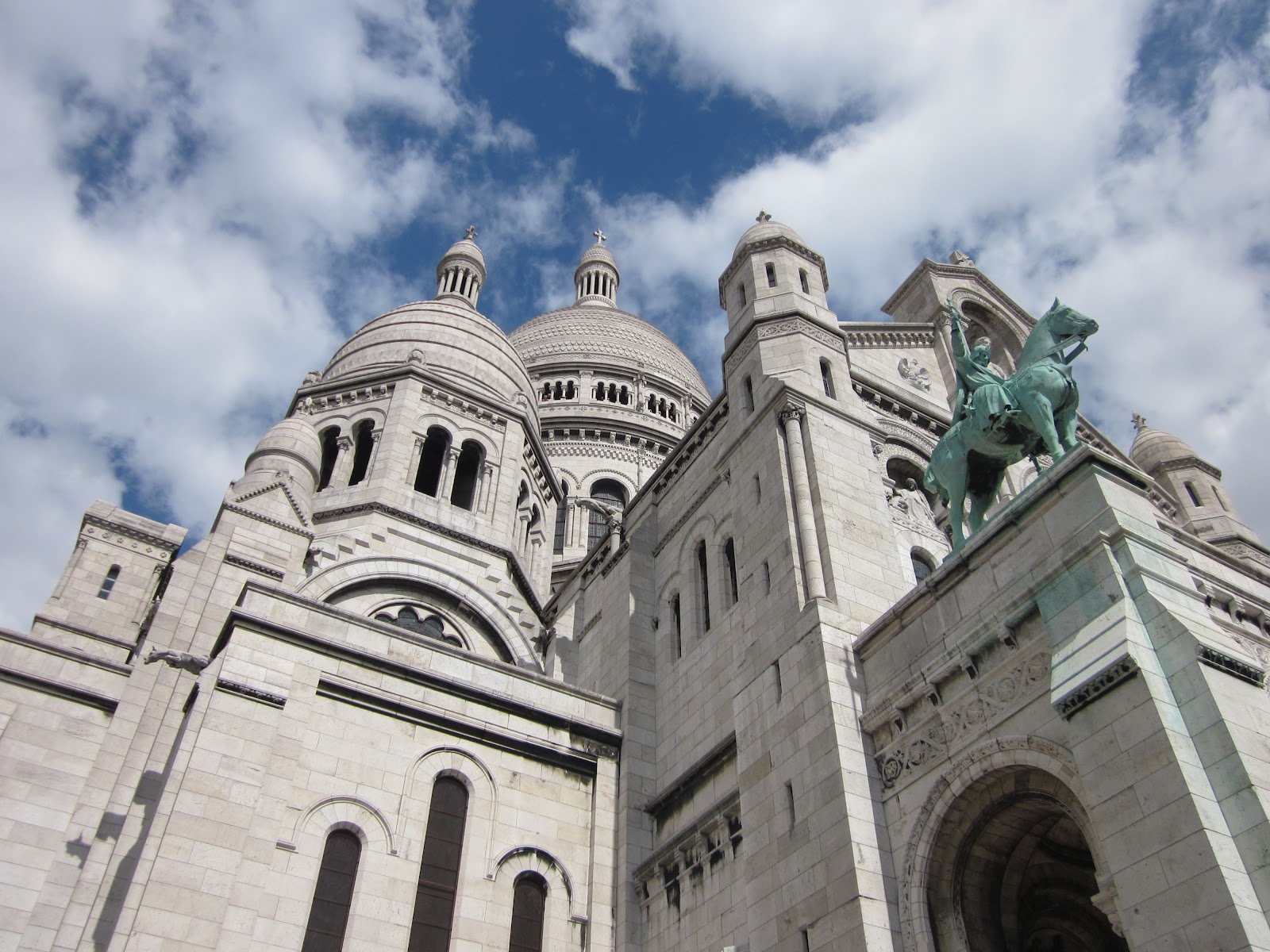
La Basalisque Sacre-coeur
"The metro is so dirty."  Honestly, the metro was no dirtier than any American system I've seen. To be fair, I may be accustomed to a certain level of filth after living in Montpellier for so long, but honestly, that's life in a city. I also enjoyed never waiting for more than two minutes on a platform (and this wasn't just traveling at rush hour times).
 

L'avenue des champs-elysées
"The Parisians are so rude." I think that this is a big cultural difference. The French (and Europeans in general, I think) are a lot less expressive than Americans. We are loud. We let everyone know how excited we are. Other than a snooty waiter at Angelina's who made fun of my French, my interaction with Parisians was very positive. Admittedly, speaking their native language helps.
A view from the top of la cathédrale Notre-Dame
 "The Mona Lisa is so small." Whoever told me le Louvre was a waste of my time was definitely wrong (I don't remember who you are, but let me take you there! I want you to have a good experience!). Not only was I thrilled to see The Winged Victory of Samothrace and other great works of art, but the building itself was incredibly beautiful. I spent three hours there and maybe got through a fourth of the museum. A revisit is definitely in my future.
La seine
I could definitely never live in Paris, but I could never live in any big city (I need fresh air when I run and green grass when I walk barefoot and trees to climb when I want to escape from the world). Paris is truly an incredible city, and I'm glad I had the opportunity to realize the error in some of my preconceptions. I can't wait to go back!

Thursday, April 12, 2012

Wine is life

Cultural Lesson # 7: French wine- making it

After a vineyard tour and several wine tastings, I have begun to realize how much passion, sweat, and labor is in each bottle of French wine (figuratively, of course). Le vin et la vie (wine is life). Take for example the town of Chateau-neuf-du-pape where I tourned a vineyard in February. This wine town has roughly 1000 inhabitants and 350 vineyards. For those of you who didn't expect to get a math problem when coming to my blog, that's more than 1 vineyard per three persons.

And linking your life to wine in France means linking your life to mother nature. In France, irrigation, heaters, and any other method that manipulates the earth are forbidden for vignerons (winemakers). This means that the flavor of the wine for any given year is completely dependent on the weather of the region. Wet, dry, sunny, cloudy, hot, cold: every change makes a difference.

The number of facteurs which effect the flavor and depth and color of wine for the proccess of growing the grapes are just as infinite for the proccess of making the wine. The barrel (type of wood and size), the temperature at which the wine is stored during fermentation, and how long the wine is left to mature all influence the final product. At Chateau-neuf-du-pape, they have found their "perfect temperature" which is maintained naturally throughout the year in their underground caverns. There were four different barrel sizes (photos to come, I'm away from my computer right now!) for the different varieties of wine.

I feel so fortunate to have been introduced to this art form at such a young age. It's not hard to understand why, for many people in France, wine is such a cultural staple. There's nothing quite like having a glass of wine with dinner that was made 40 km down the road!

Tuesday, April 10, 2012

Une dégustation de vin

Cultural Lesson # 6: French Wine- Tasting it

Method for wine tasting:
1) How does the wine look? Hold the wine up to the light or to a white background and observe its true color. Color is our first indication of how the wine will taste (red, white, rosée, etc.).
2) How does the wine smell? Stick your whole nose into the glass (don't feel silly!). One wine guide once told our group that you may have a certain nostrile more sensitive than the other. You want to try to discern the different scents that make up the wine (ex. floral, wood, fruit, or spices). Everyone has the capacity to identify scents and flavors, it is just a matter of what your mental catalogue is. Ever since my first vineyard tour, I have taken every opportunity to eat a new type of fruit and to really memorize the scent and flavor.
3) Swirl like a snob. It's not pretentious, it's necessary! Performing this motion for 10-20 seconds aerates the wine and releases the vapors allowing you to better perform step 4.
4) Smell it again! In addition to discerning the different scents, note whether or not it smells good to you. Is it making you salivate (I know this sounds weird, but just be mature about it)? Is it a wine you want to drink?
5) Finally the tasting! Only after using all of your other senses are you ready to use your taste buds! It is best to sip the wine and get as much oxygen in your mouth as you can (by sort of sucking air in through your teeth as the wine is in your mouth). Make sure you roll the wine through all parts of your mouth before you swallow (or spit it out, if you're classy like me and don't want to get tipsy at a wine tasting). Different parts of our mouth detect different types of tastes.
6) Wait for it! The aftertaste is also very important when assessing a wine.

Basically, I'm a wine snob now.


Stay tuned for part two where I talk about French vineyards and the wine making process!

Sunday, April 8, 2012

Bon Appetit

Cultural Lesson #5: Bon Appetit

This French phrase is definitely not a foreign to American ears. From titling a cooking magazine to appearing on Garfield comic strips, this phrase like "rendez-vous" and "déjà vu," has been welcomed into the English language. But, before coming to France, every time I heard someone use bon appetit, it didn't mean very much; it was just a goofy thing to say. It's so French (like the baguette or accordion music) that it's almost  stereotypical. You begin to even wonder if it's something said outside of the dinner tables and restaurants of American movies set in France or scrolled at the bottom of a menu at a fancy restaurant.

I'm here to tell you that bon appetit is so much more than just a fun thing to say before starting a meal. It goes back to the idea that French people see meals as less of a time for nourishment and more of a time to share food around the same table. Everyone says it. You say it at family dinners, friendly picnics, restaurants, and even when just grabbing a crepe from a stand with a friend. If I walk by the kitchen and see my host mother eating breakfast or lunch, it's polite for me to say "bon appetit." It's even considered normal for a stranger to say it to you if you're eating your lunch on a park bench.

It's one of the things I could use to rebut the stereotype of French as cold and standoffish. Food brings us all together. For your next meal, I wish you bon appetit!

PS) I will be blogging all this week, as I have internet access and a computer!

Wednesday, April 4, 2012

Not quite marching band

Cultural Lesson # 4: Fanfare

 So, I had always learned that the French word for Marching Band was "fanfare." This word pleased me (hello, French syntax!), because it brought to mind images of valiant trumpet-bearing soldiers marching down the Champs Elysées. But, when I first saw a fanfare in France, I realized that, while the two groups have similar spirit, they are not quite the same.

This is from a music and lights festival in the Cartier de Beaux Arts

A fanfare, as I have come to experience and understand it, is a type of street band. A lot of the times they'll wear silly costumes (I think that my pictures were taken on a fire & ice theme night). They have pep-band instruments (trumpets, trombones, sousaphones, clarinets, saxophones, and a drum set). They also play "popular" music. I put popular in quotes because I heard Rock Lobster at least twice (that's for you, Tim!). They also played a lot of 90s grunge music. This may have just been the repertoire of this particular group.

You can see some of the silly clothing people were wearing in this picture
 The pictures I have aren't wonderful for a few reasons. This was back in January when I was still terrified of being mugged at any given moment (thanks to our program leader, for that pep talk). But also because there was a delightful man who was way past inebriated who was swaggering around our group the whole night. It was a bit of a challenge to keep out of his way when he would fall backwards like a tree that's just received the final blow from an axe. There were several men who tried to relocate him to sit down a park bench, but he wouldn't have it. His belligerence was a telling sign of his love for Rock Lobster and fanfares.

We could not figure out why, but there were feathers EVERYWHERE


 Ignore the images on the video, this is just to give you a taste of what it sounded like. They had been playing for awhile and it was pretty cold, but you can tell that this group is a casual, just-for-fun thing. Definitely can't stand up to the Pride of the ACC.

Wednesday, March 28, 2012

Parlatz occitan?

Cutural Lesson #3: Occitan Culture 

So (according to Wikipedia), Occitania is the region in Southern Europe (mainly France, Monoco, some parts of Italy, and some parts of Spain) where Occitan was historically the main language spoken. In fact Languedoc-Roussillon (the region of France to which Montpellier belongs) is a derivative of "langue d'oc" or language occitan.

Now, there is a man who works at Accent Français who is Occitan and who is just about the coolest person you will ever meet. He speaks a plethora of languages (Occitan, French, English, Spanish, Italian, German, bits and pieces of Japanese, etc. etc.), knows the history and culture of all of the towns worth visiting in the South of France, and plays a wooden flute everywhere he goes. He is in charge of cultural excursions at Accent Français, and today he organized a couple of hours of teaching Occitan Dancing for those who were interested.

You all know how much I love dancing, so of course I went! It was a wonderful way to spend a sunny spring afternoon in Montpellier. I wish I had pictures, but I was so busy busting a move that I wasn't able to capture any. We learned something like four to five different circle dances (I wish I'd know them before I went to Avignon!) in the Place du Peyrou where many a tourist gaped at the spectacle we were making.


And, after a quick youtube search, you are in so much luck! This is from a few years ago, but it is the same dance and the same Jean-Paul (our Occitan guide!).


Can't wait to bring it back to Chapel Hill! It'll be a thing, just you wait.


PS) Here is a picture of me and my friend practicing our moves. I think it's safe to say that we mastered the dances!
Photo by Beth Moroney

Sunday, March 25, 2012

Le jazz


Cultural Lesson # 2: Le jazz français


If anyone is looking for some good French music recommendations, I have some! I haven't been able to stop listening to a few artists recently, and they're so good that I have been trying to find excuses to share them with people. 


The first artist is ZAZ who is described as a pop singer with gypsy jazz influences. Le jazz manouche (or gypsy jazz) was born in the 1930s with group of gypsy musicians called Djanjo. Originally, this music was sans percussion and relied heavily on acoustic guitar and also the violin, clarinet, and accordion. A rhythmic guitar replaced the traditional percussion set-up. Most of her music makes use of traditional percussion, but you can still just feel the influence of the jazz manouche.


ZAZ- Ni oui ni non(2010)


The second artist is Le Comptoir des Fous. This group, self described as swing'n'roll is actually from Montpellier! They remind me a lot of the zydeco music to which I've listened, and I just feel like eating a big bowl of gumbo and dancing on Bourbon Street when I'm listening to them. They should blast this in the Tar Heel locker room to get our boys motivated (Go Heels!).

Le comptoir des fous- Pourquoi s'emmerder


Happy swinging!

Saturday, March 24, 2012

Le marchée

I've decided that in addition to my "peur du jour"s I'm going to mix in some cultural lessons for everyone!

 Cultural Lesson #1: French Markets

Today's lesson is (as the title indicates) about French markets (pronounced mar-SHAY). Since I don't drink coffee and try not to blow my budget on French pastries and wine, going to the market is the thing I do that makes me feel the most French. Every Saturday morning I get up early (for a Saturday in France) to go to le marchée des arceux (the market that is under the arches of the aqueduct). Because I live in centre-ville and the market is just outside of the main part of town, I get to observe the activity in Montpellier during my 15 minute walk.

La place de la comédie

I always see something noteworthy while walking through the place de la comédie (the heart of town). This morning I heard a fanfare (I'll probably do a cultural lesson about this later) playing. Other times there will be protests, street performers, and other colorful manifestations of human activity (like the gypsy petting zoo). While walking through le jardin de Peyrou, I'm usually always harangued by someone trying to get me to sign something or give them money. You'd think that, as a university student, I would be used to this and would be skilled at avoiding interaction with these people. However, I've found that people who want something from you are a lot more aggressive in France. One time a gypsie girl saw me from across the park and made a beeline for me. She was only about 10 or 11, so I wasn't too concerned. But as I said "merci" and stuck my hand out like a stop sign (I learned from my Northern friends that this is a very French thing to do), she latched on to my elbow and would not let go. I literally had to shake her off. I felt bad because she was so young, but at the same time, it's definitely NOT okay to physically interact with someone like that...

Jardin de Peyrou (beware of gypsie girls!)

Now to the fun part! The market! I've already talked about the market in Arles (which is the biggest of it's kind in France, or at least in the South of France). Montpellier's Saturday market may be smaller, but it's of no lesser quality! Every time, I wander to the same stand at the opposite end of the market to buy apples and carrots for the week.
Under these arches, the vendors set up their stands!
During this journey, one thing I love to do is close my eyes and guess which stands I'm passing (I can ALWAYS guess the olives). In my head I'm always drafting detailed descriptions (and sometimes even poetry) of what I'm experiencing, so today I decided to stop to note some of the things that I find the most striking. I always marvel at the seas of olives whose scent I drown in, the chickens whose necks and clawed feet still dangle from their bodies and the rabbits whose eyes watch over the passersby, the piles of fresh, crusty bread, miles of fresh cheese pressed with rosemary and thyme, a rainbow of homemade jams, yards of sausage in curled heaps, burlap sacks brimming with dried herbs and spices, hills of lettuce and radishes, apples in every color, crates upon crates of pears and oranges, row after row of strawberry cartons, pyramids of fresh farm eggs, succulent pastries and cakes heaped with chocolate and fruit, a jungle of fresh-cut and potted flowers, canopies of scarves and cloth, and beaches of jewelry that glitter in the sunlight.


And the people are usually just as interesting. There is always the Arab man with his cart selling mint tea, a man playing the ukulele, puppeteers with marionettes, and a number of people soliciting religious and political causes.


Now, markets are a huge cultural thing for a lot of reasons. The first reason being that food is life in France. Meals are less about "nourishing" as we tend to think of them in America and more about "sharing" and "enjoying." I tend a be a I-eat-what-is-put-in-front-of-me type of person. But my host mother always talks about how you shouldn't eat something unless it really brings you pleasure to eat it (I agree to a certain extent, but I don't think she's ever had to eat dining hall food). But in seeing food differently, I think the French take a lot more pride in buying the best ingredients (which of course come from the markets and not the SUPERmarkets). Of course, I know this exists in the US as well (the best corn in the world is sold at the Grayslake farmer's market... yum!), but it's just such a part of mainstream culture here.


Another reason that markets are culturally significant is that they are such a smorgasbord (had to use spell check for that word) of regionally distinct products. I've tried to buy only local products while in France (I figure that I can eat Brazilian bananas in the United States) which is easy to do at the markets. There are all sorts of French,  Mediterranean, and middle eastern (which really is a part of the culture here) specialties. I like to taste the different olives and cookies and breads; I'll even occasionally buy something for lunch from the market (my eye is on the paella for next time!). Not only is each stand brimming with edible cultural manifestations, but also each vendor is brimming with knowledge. When the market's not very busy (which is not often now that le grand froid is over), I love to talk to the vendors about their food! They're so proud of what they do and are always happy to share knowledge with a bright-eyed bushy-tailed American student.


Markets are one thing I'm really going to miss about France!